
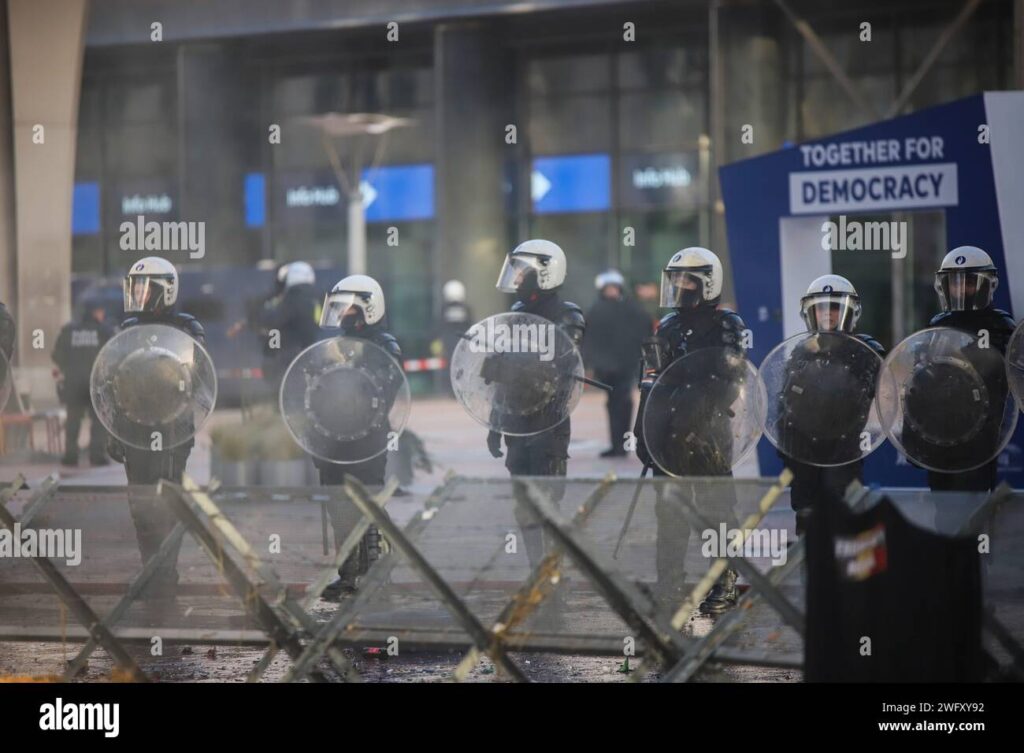

The EU signed the Mercosur free‑trade pact on 17 January despite a continent‑wide wave of farmer protests that shut roads, ports and even a French oil terminal. Brussels now faces a race‑against‑time to soften the blow with extra cash and regulatory tweaks, or risk a prolonged backlash that could choke supply chains and dent the bloc’s climate credibility.
The flashpoint was the Commission’s 8 January decision to green‑light the deal, followed two days later by a tighter nitrate‑pollution framework that imposes new charges on diffuse agricultural runoff. Within hours, French tractors formed a straw‑bale barricade at La Pallice in La Rochelle, Polish farmers blocked more than 160 road points across the country, and German drivers rolled 350 tractors through Paris on 8 January. A further sit‑in at the European Parliament is slated for 20 January, underscoring how quickly the unrest has moved from farms to the heart of EU institutions.
In France, the FNSEA has turned the protest into a high‑visibility siege of the nation’s logistics. Its core demands – an “agricultural emergency law” that unblocks stalled water projects, freezes the diffuse‑pollution charge and suspends water‑related decisions until new EU guidance arrives – are being aired on the front pages and at the barricades. “We cannot let cheap South‑American meat flood our markets while we are forced to pay ever‑higher water fees,” a senior FNSEA spokesperson told reporters on the ground, while farmers in Le Havre throttled the port’s loading bays with tractor convoys.
Poland’s ZKR has taken a more dispersed but equally relentless approach. The union has staged road blockades from Wiskitki to the Baltic coast and organised a symbolic march from the EU office in Warsaw to the National Theatre, coinciding with the country’s EU Council presidency. Its demands focus on exemptions from the new nitrate limits, higher direct CAP payments for small farms and protective measures against cheap imports. “If the EU does not grant us real derogations, we will keep the highways clogged until the government is forced to listen,” warned Krzysztof Olejnik, ZKR’s chief negotiator.
German growers, coordinated by the DBV, have coupled massive tractor convoys with a climate‑centric message. While 350 tractors thundered through Paris, the DBV simultaneously rallied low‑emission machines, demanding subsidies for green technology and a “review clause” that would let the EU reassess Mercosur if it undermines climate goals. The association has also hinted at legal action, arguing that the deal conflicts with Europe’s own emissions targets. “We are not anti‑trade, we are anti‑damage to our farms and to the planet,” a DBV representative told a Brussels briefing.
In response, the Commission has drafted a package that bundles “reassurances on payments to European farmers” into the 2028‑2034 multi‑annual budget, tapping the €300 billion ring‑fenced CAP fund and the €6.3 billion Unity Safety Net. On the regulatory side, officials are flirting with broader derogations for Member States that can prove effective local water‑management, a move that would directly address French and Polish pleas. A “review clause” for Mercosur – allowing the EU to pull the plug if market distortions surface – is also on the table, a concession championed by both France and Germany. Trade Commissioner Maroš Šefčovič and Agriculture Commissioner Christophe Hansen will chair a farm‑ministers’ meeting in early January, the decisive arena where these concessions will be hammered out.
The episode lays bare a fundamental test for the Union: can it reconcile ambitious trade liberalisation and climate‑driven regulation with the survival of family farms that feed Europe? If the Brussels package satisfies the FNSEA’s water‑project demands, ZKR’s nitrate exemptions and DBV’s climate safeguards, the protests may dissipate and the Mercosur pact can move forward. A failure, however, would deepen the rift between Brussels and the countryside, threaten the credibility of the CAP reform, and give populist forces a fresh rallying cry. The next few days in Brussels will determine whether European agriculture is steered into a more resilient future or left to battle the twin storms of market pressure and environmental compliance.
Image Source: www.alamy.com