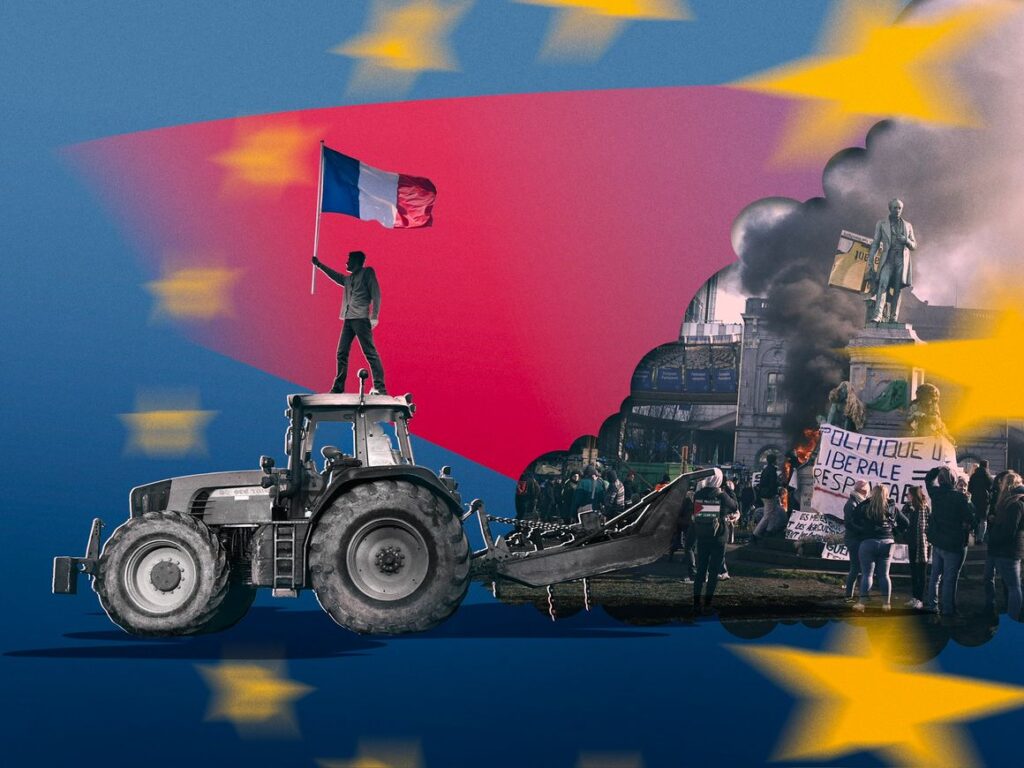

The streets of the Loire Valley are a sea of orange vests and tractors, a rolling protest that has turned the EU‑Mercosur deal from a distant trade paper into a battlefield for French farmers. In the chill of a December dawn, a chorus of angry voices shouted that cheap South American meat will drown family farms, and the government’s silence is being read as a green‑light for disaster. The rally that began in March 2024 has now erupted into a coordinated Southern European push that could stall one of the continent’s most ambitious trade pacts.
I arrived at a makeshift camp outside the town of Saumur, where Jean‑Michel, a third‑generation pork producer, stared at his empty pens and warned, “If the tariff‑free beef and pork from Brazil pour into our supermarkets, we will be forced to sell at a loss or shut down altogether.” His concern mirrors a broader calculation: French pork and beef sectors estimate a 5‑10 % price drop within two years of full liberalisation, a hit that would rip through the margins of family‑run farms across the Mediterranean basin. The protestors’ anger is not abstract; it is rooted in the deal’s core provisions that strip away duties on beef, pork, poultry, dairy, soy and sugar – commodities that dominate the agricultural output of France, Spain, Italy and Portugal.
The text of the agreement offers little comfort. Its sanitary‑phytosanitary safeguards are reduced to “mutual recognition” and a vague “public‑policy” clause, leaving the door open for livestock carrying diseases such as contagious bovine pleuropneumonia to slip past EU health controls. Moreover, the environmental pledge to respect the EU’s no‑deforestation clause is merely voluntary, with no binding enforcement to curb Amazonian soy and cattle expansion. For farmers accustomed to stringent EU standards, the pact feels like a surrender of both health and climate safeguards for the sake of market access.
Sidebar – Mercosur’s ripple in Spain and Italy
In Spain, the pork‑rich plains of Castilla‑La Mancha have seen solidarity rallies echoing the French demand for “conditional safeguards”. The Ministry of Agriculture has pledged to lobby for deforestation‑free certifications before the EU vote, fearing that cheap South American pork could undercut Spanish producers and push prices down the same 5‑10 % range feared in France. Italy, traditionally a pro‑trade ally, has now joined the call for a “technical pause”. Prime Minister Giorgia Meloni’s government submitted a joint diplomatic note with France on 15 December, urging the European Council to reassess SPS and environmental clauses. Italian dairy cooperatives warn that tariff‑free Argentine milk powder would flood the market, eroding the premium that protects Parmigiano‑Reggiano and other regional specialties.
The French mobilisation has become a catalyst for diplomatic pressure across the Mediterranean. Portugal’s FNCA organised truck convoys converging on Lisbon, while Greece’s rural ministry issued a joint statement demanding enforceable deforestation‑free clauses, citing the French protests as a precedent. These coordinated actions have forced the European Parliament’s Trade Committee to draft an amendment granting the Commission the power to re‑impose tariffs temporarily if imports cause “serious market disruption”. The amendment, a direct response to farmer lobbying, signals a shift from the EU’s usual reliance on market‑driven mechanisms to a more protective, trade‑defence stance.
Meanwhile, the European Commission announced a rapid impact assessment of the Mercosur pact, citing the “widespread mobilisations” as the impetus for a deeper review. If the assessment confirms the feared price drops and health risks, the EU could postpone the ratification vote, compelling the South American bloc to renegotiate the most contentious safeguards. Such a delay would hand Southern European farmers a rare bargaining chip, potentially reshaping future trade agreements to embed verifiable environmental and health standards.
The outcome of this farmer‑led crusade will determine whether the EU‑Mercosur pact proceeds as drafted or is forced to bend to the realities of Mediterranean agriculture. As tractors line the highways and slogans echo from field to parliament, the message is clear: Southern Europe will not surrender its farms, its standards, or its climate commitments without a fight.
Image Source: www.politico.eu