
Germany has just signed the biggest post‑war weapons order in its history – a €50 billion, 30‑project package that will reshape the Bundeswehr and, by extension, Europe’s defence market. Approved by the Bundestag’s Budget Committee in December 2025, the programme bundles missiles, artillery, armoured platforms and a radar‑satellite system into a single, legally binding procurement drive that signals a new, market‑driven phase of NATO’s European revival.
The hardware list reads like a modern‑war catalogue. On the air‑defence front Germany will receive PAC‑3 MSE missiles to augment its Patriot batteries, the short‑range IRIS‑T SLM system to replace ageing Flak guns, and Meteor air‑to‑air missiles for Eurofighter fleets. Ground firepower is bolstered by up to 84 RCH 155 self‑propelled howitzers – a €1 billion slice of the spend – with a follow‑on order that could lift the total to 229 guns. The armoured fleet swells with 200 additional Puma S1 infantry‑fighting vehicles (€4.2 bn), 218 wheeled CAVS “Transportpanzer NG” units, a first tranche of roughly 3 000 Eagle V transport and command vehicles (€4.8 bn) and a €21 bn FASER programme for personal and crew equipment. Topping it all is the SPOCK radar‑satellite system, a joint Rheinmetall‑Iceye venture valued at €1.76 bn, with optional extensions that could push the price past €2.7 bn by 2030.
To make such a sprawling purchase legally tenable, Berlin has rewritten its defence‑acquisition law. The amended Act on Accelerated Planning and Procurement creates a “single point of contact” for project promoters, suspends mandatory lot‑splitting until 2030 and authorises negotiated procedures without prior publication when interoperability demands specific products. These shortcuts dovetail with EU public‑procurement rules – a 50‑working‑day decision window, extendable by 25 days for large contracts, and a tacit‑approval fallback if deadlines slip. In practice the changes embed the German effort within the EU’s Readiness 2030 agenda, PESCO’s joint capability goals and the European Defence Fund’s collaborative acquisition model, ensuring that every euro spent carries a “Buy European” tag.
The financial ripple is already being felt on the stock market. Since the start of 2025 the STOXX Europe Aerospace & Defence index has surged more than 50 per cent, and on the day of the vote German defence stocks jumped – Renk up 2.8 per cent, Hensoldt 2.4 per cent, Rheinmetall 1.8 per cent. Over the year Rheinmetall’s share price has more than doubled, a clear market verdict that the programme “improves current revenue visibility”. Directly, the €50 bn spend translates into multi‑year orders for Rheinmetall (SPOCK, RCH 155), Airbus Defence & Space (satellite ground segment), Krauss‑Maffei Wegmann, Diehl and MBDA (Puma, IRIS‑T, Meteor). These contracts lock in production lines for the next decade and guarantee thousands of high‑skill jobs across the German supply chain, from precision‑machining to software development.
Beyond headline numbers, the programme is a catalyst for industrial consolidation. Consortia such as ARTEC (RCH 155) and the Patria‑led CAVS platform are being forced to pool R&D, share tooling and synchronise delivery schedules, trimming duplication and sharpening Europe’s export edge. The technology spill‑overs are equally significant: satellite‑ISR expertise will seep into civilian aerospace and telecommunications, while the digital systems that power Puma IFVs will feed German automotive and robotics firms, reinforcing the country’s high‑tech ecosystem.
Export potential is baked into the contract’s architecture. Mandatory industrial participation clauses reserve a slice of work for non‑German EU firms, inviting French, Italian and British suppliers into the value chain. The SPOCK satellite, co‑developed with Finnish specialist Iceye, is already being pitched to NATO allies seeking all‑weather radar imagery, and the Puma and RCH 155 platforms have attracted interest from Sweden and the Netherlands. In short, Germany is positioning itself as a hub for next‑generation armoured and artillery systems that could dominate the European market once the initial orders are fulfilled.
Geopolitically, the €50 bn package is a decisive statement that Europe will shoulder more of its own security. By aligning the procurement with EU‑wide readiness targets, Berlin is feeding the “Readiness 2030” fund that aims to mobilise up to €800 billion of defence investment across the bloc. The move strengthens NATO’s eastern flank – the SPOCK system will feed live radar imagery to the 45th Armoured Brigade in Lithuania – while simultaneously deepening intra‑EU defence cooperation, a cornerstone of PESCO’s ambition to reduce reliance on US‑led supply chains.
In sum, Germany’s historic weapons order is more than a procurement exercise; it is a market‑driven engine of capability, industrial renewal and strategic autonomy. By binding missile, artillery, armoured and space assets into a single, EU‑aligned package, Berlin has turned a budget line into a lever that will reshape the European defence landscape for the next decade.
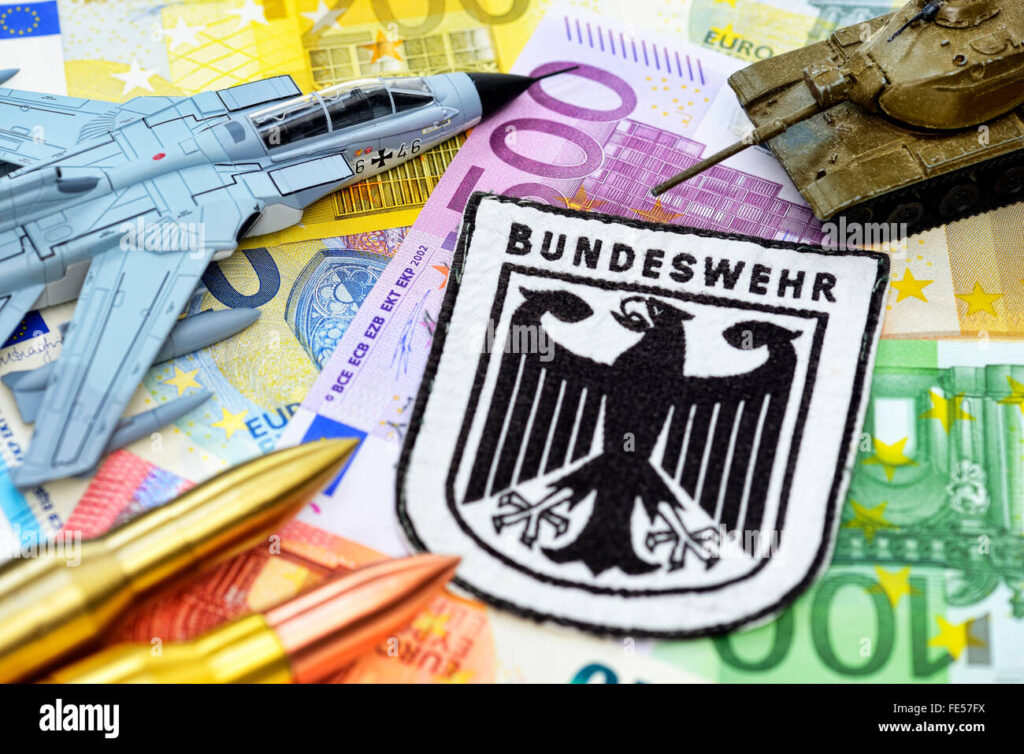
Image Source: www.alamy.com