
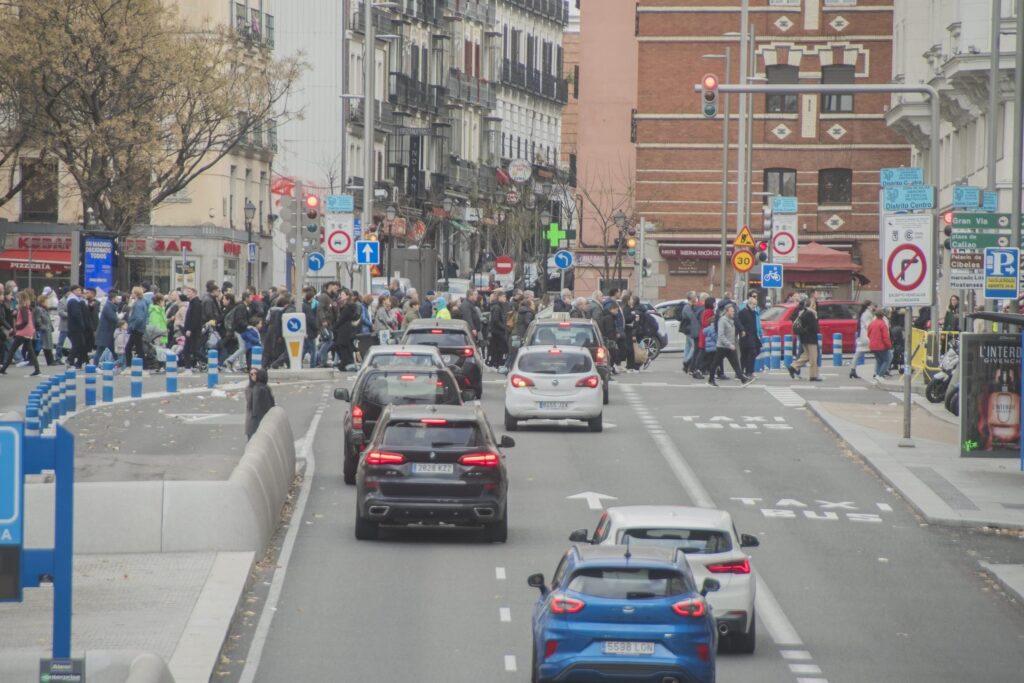

Madrid has rolled back its clean‑air deadline, giving the roughly 15 000 oldest petrol cars a one‑year grace period until 31 December 2026. The city council announced the postponement on 11 December, citing a court ruling that forced a “pragmatic compromise” with motorists Madrid’s decision to extend the low‑emission ban by twelve months.
The exemption applies to any vehicle that lacks a DGT environmental label – essentially pre‑2000 petrol models that fall outside even Euro 1 standards. According to the council, the fleet numbers between 14 000 and 15 000 cars the only vehicles that will benefit from the postponement, representing about 0.05 % of Madrid’s resident population and well under 0.1 % of the city’s 4.8 million daily vehicle movements the exemption’s share of overall traffic is negligible. The rule is lifted city‑wide except for the two “Special‑Protection” zones – Madrid Central and Plaza Elíptica – where unlabelled cars remain banned the extension does not apply in the most polluted districts.
Even a modest fleet can be quantified. Pre‑2000 petrol cars emit on average 210 g CO₂ km⁻¹, 0.35 g NOₓ km⁻¹ and 0.012 g PM₂.5 km⁻¹ external studies on old Spanish vehicles estimate these figures. Assuming 12 000 km per year, the 15 000 exempt cars would add roughly 378 000 t CO₂, 630 t NOₓ and 2.2 t PM₂.5 annually – about 0.04 % of Madrid’s total traffic CO₂ output and 0.3 % of its NOₓ inventory the extra emissions are modest but not zero. To soften the impact, the council earmarked €4 million for vehicle‑renewal programmes in 2025 and will keep a €1 500 scrappage incentive for owners who replace a non‑labelled car in 2026, part of a broader €111 million “vehicle‑renewal” package the city’s financial push to accelerate fleet turnover.
Madrid’s back‑pedal stands out against the tightening trends in London, Paris, Berlin and Rome, where ultra‑low‑emission zones are either already city‑wide or set to tighten in the next few years other EU capitals are moving forward, not backwards. London, for example, charges £12.50 per day for non‑compliant cars, while Paris imposes a 24‑hour “pass” for Crit’Air 3 vehicles the contrast is stark. The European Environment Agency notes a 57 % drop in air‑pollution‑related mortality between 2005 and 2023, driven in part by such city‑level schemes EU progress hinges on continued tightening.
Quick‑read FAQ
– Who benefits? Owners of pre‑2000 petrol cars without a DGT label – about 15 000 drivers.
– Where does it apply? City‑wide, except Madrid Central and Plaza Elíptica.
– What’s the environmental cost? ≈ 378 000 t CO₂, 630 t NOₓ and 2.2 t PM₂.5 for one year.
– Any financial help? €4 million for renewal programmes, €1 500 scrappage incentive, €111 million total package.
Impact snapshot – an infographic‑style table would show the tiny fleet share (0.05 % of residents), the modest emission rise (≈ 0.04 % of CO₂), and the €4 million mitigation budget, putting the extension into perspective for commuters and tourists alike.
Drivers on the ground have mixed feelings. A local motorist quoted by Euractiv said the extra year “gives families time to save for a new car”, while a Guardian‑reported environmental group warned it “delays Madrid’s air‑quality targets”. The council’s “pragmatic compromise” may ease immediate hardship, but without a robust emissions model or a usage charge, the policy risks becoming a temporary loophole rather than a stepping‑stone to a cleaner future.
Image Source: www.theolivepress.es