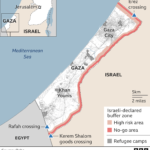


The United States has just turned a war‑torn enclave into a headline‑making promise, unveiling Project Sunrise as a ten‑year, £79 billion ($112 billion) reconstruction engine for Gaza. The plan, billed as a humanitarian lifeline, carries a political heft that could either heal or harden the region’s fragile status quo.
Project Sunrise sketches an audacious transformation: Gaza should evolve from a blockade‑strapped outpost into a high‑tech, coastal metropolis. The vision covers energy, housing, transport and public services, with the U.S. pledging to anchor at least 20 % of the bill – roughly $22.4 billion – to signal confidence and attract further donors. The ten‑year horizon gives the programme a quasi‑state‑building ambition, positioning the U.S. not just as a donor but as a strategic partner in reshaping a key flashpoint.
The funding architecture is a hybrid of taxpayer grants, new debt and private contributions. Congress has earmarked $41.9 billion in grants and $15.2 billion in new debt for public financing, leaving the remainder to be supplied by multilateral institutions and the private sector. USAID is tasked with the on‑ground delivery, while the State Department oversees policy alignment and Treasury/OFAC enforces sanctions to keep the money from flowing to Hamas‑affiliated entities. Section 309 of the Gaza Act requires joint certification to Congress that oversight mechanisms are in place, and an $4 million budget has been allocated to the Inspectors General for end‑use monitoring.
Private partners bring both expertise and potential risk. The World Bank is slated to provide concessional loans and technical assistance, while Gulf and Israeli firms – including the Abu Dhabi National Oil Company – are eyeing Gaza’s offshore gas fields as a revenue source for reconstruction. The plan hints at a future where coastal development could generate $55 billion in long‑term returns by year ten, theoretically creating a self‑sustaining funding stream for ongoing maintenance and social services. Yet the very involvement of entities with ties to the UAE and Israel raises questions about the flow of money through actors that the EU considers hostile.
EU sanctions against Hamas‑affiliated organisations remain one of the EU’s most stringent tools in the region. The EU’s regime is designed to choke off financing for the organisation and its affiliates, but the current publicly available information does not clarify how these sanctions are woven into the Project Sunrise framework. Likewise, the EU’s diplomatic agenda – stability and a two‑state solution – is not explicitly linked to the U.S. reconstruction plan, leaving a gap between policy intent and operational detail.
This mismatch between U.S. oversight and EU sanctioning creates a precarious space. While Treasury’s OFAC provisions and USAID’s monitoring aim to keep funds out of prohibited hands, the lack of a transparent, EU‑aligned compliance regime means that private partners could inadvertently funnel resources to entities the EU has black‑listed. The potential use of gas revenues, in particular, is a red flag, given the EU’s firm stance on Hamas‑affiliated finance.
In short, Project Sunrise is a bold attempt to re‑engineer Gaza’s future, but its success hinges on more than a generous budget. The U.S. must bridge the gap between its own counter‑terrorism safeguards and the EU’s sanctions framework, and it must bring the private sector – especially firms with Gulf and Israeli links – under a common, transparent compliance umbrella. Only then can the programme move beyond rhetoric and deliver on its promise of a stable, prosperous Gaza that aligns with both American strategic interests and European diplomatic objectives.
Image Source: www.istockphoto.com